

Most bettors assume the loudest voices online know something they don't. That assumption is expensive. Influencer picks average a staggering negative 25% ROI, meaning following social media tipsters is, statistically, a reliable way to lose money. Yet the sports betting space is saturated with confident personalities claiming edge, selling picks, and posting screenshots of wins without ever showing the full record. This article cuts through that noise. We'll define what genuine expert betting analysis looks like, explain the market forces that constrain even the best bettors, and give you a clear framework for applying evidence-based methods to your own approach.
Table of Contents
- What makes betting analysis 'expert'?
- Market efficiency and the limits of edge
- Key tools and metrics for expert betting
- Applying expert analysis: From theory to real bets
- Why most so-called 'expert' advice misses the mark
- Level up with expert-driven community support
- Frequently asked questions
Key Takeaways
| Point | Details |
|---|---|
| Evidence outperforms intuition | Data-driven tools and rigorous benchmarking distinguish real experts from trend followers. |
| Market efficiency is the real opponent | Long-term edges are tiny (1-3%), so volume and disciplined tracking are essential for profit. |
| No shortcuts to sustained wins | Influencer tips and emotional bets consistently underperform—success demands process, not luck. |
| Metrics matter most | Closing line value, expected value, and precise bet tracking are fundamental for measuring expert skill. |
What makes betting analysis 'expert'?
The word "expert" gets thrown around loosely in betting circles. Someone hits a five-leg parlay and suddenly they're a guru. But real expertise has nothing to do with a hot streak. It comes down to a disciplined, repeatable process built on evidence, not instinct.
At its core, defining expert analysis means separating decisions driven by data from those driven by narrative. An expert bettor doesn't back a team because they "feel hot" or because a popular account said so. They calculate expected value, model probabilities, and compare their estimates against market odds to identify genuine discrepancies.
What separates expert analysis from opinion:
- Model-based probability estimates: Experts build or use statistical models that assign win probabilities independent of public sentiment.
- Expected value (EV) calculation: Every bet is evaluated by whether the implied probability in the odds underestimates the true probability of the outcome.
- Calibration tracking: Experts measure how accurate their probability estimates are over time, not just whether they win or lose.
- Benchmark comparison: Performance is measured against sharp market lines, not just profit or loss in isolation.
Data-driven approaches using machine learning models and EV calculations consistently outperform gut-feel or emotionally driven betting. The general public loses to the vig at roughly 4 to 5% ROI, simply because they're not accounting for the built-in house margin on every bet.
| Analysis type | Basis | Long-term ROI potential |
|---|---|---|
| Influencer picks | Opinion, trends | Negative 25% average |
| Public consensus | Popularity, narrative | Negative 4 to 5% (vig loss) |
| Model-driven EV betting | Statistical models | Slim positive edge possible |
| Expert calibrated systems | Benchmarked, tracked | Best long-term outcome |
"True expertise in betting isn't about picking winners. It's about consistently identifying when the market has mispriced an outcome and having the discipline to act on that edge over hundreds of bets."
This distinction matters because it reframes what success looks like. A losing month doesn't mean your model is broken. A winning month doesn't mean your gut is reliable. Expert analysis demands you evaluate the process, not just the outcome.
Market efficiency and the limits of edge
Understanding expert analysis is only half the equation. The other half is understanding what the market itself will allow. Betting markets, especially at sharp books like Pinnacle, are remarkably efficient. They aggregate information from thousands of sophisticated bettors and adjust lines accordingly. That efficiency creates a ceiling on how much edge anyone can realistically hold.
Market efficiency limits edges to roughly 1 to 3% for even the most skilled bettors. That's not a typo. The best in the world are working with margins that look thin on paper but compound meaningfully over large sample sizes. This is why volume is everything.

| Sample size | Edge reliability | Variance risk |
|---|---|---|
| Under 100 bets | Very low | Extremely high |
| 100 to 500 bets | Low to moderate | High |
| 500 to 1,000 bets | Moderate | Manageable |
| 1,000+ bets | Statistically meaningful | Low |
Sharp bettors don't celebrate a 10-game winning streak. They know variance can produce that result even with zero edge. What they care about is whether their edge holds across 1,000 or more bets, where luck averages out and skill becomes the dominant factor.
Simulations also show that value betting with Kelly staking can produce short-term gains, but long-term profit remains elusive for most because market efficiency continuously erodes any edge that becomes widely known or exploited.
Pro Tip: Never evaluate your betting performance on fewer than 500 bets. Anything less is noise. Winning streaks and losing streaks below that threshold tell you almost nothing about whether your approach actually has edge.
Variance traps are the silent killer for aspiring elite sports bettors. A progression system like doubling down after losses feels logical but is mathematically destructive. Short samples make bad strategies look good and good strategies look bad. The only protection is volume, rigorous tracking, and patience.
Key tools and metrics for expert betting
Knowing that edges are slim and markets are efficient, how do experts actually measure whether they have one? The answer lies in specific tools and metrics that go far beyond win rate or profit.
The essential metrics every serious bettor tracks:
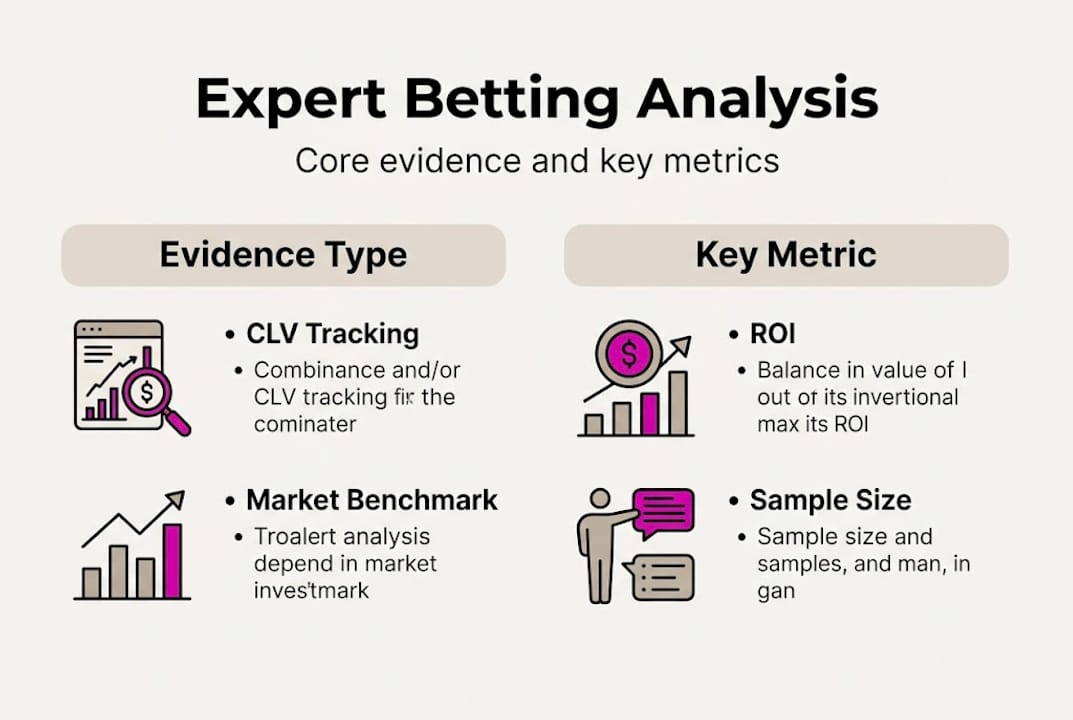
- Closing Line Value (CLV): This measures whether the odds you bet at were better than the closing line. Consistently beating the close is the strongest signal of genuine edge.
- Expected Value (EV): Calculated as (probability of winning x potential profit) minus (probability of losing x stake). Positive EV bets are the only bets worth placing.
- ROI by market type: Breaking down returns by sport, league, and bet type reveals where your edge actually lives and where it doesn't.
- Calibration score: How well do your predicted probabilities match actual outcomes? An expert whose 60% confidence picks win 60% of the time is well-calibrated.
- Flat stake ROI vs. Kelly ROI: Comparing both reveals whether your staking method is adding or destroying value.
Pinnacle closing lines are widely regarded as the sharpest benchmark available, with a calibration error of under 1%. If you consistently beat Pinnacle's closing line, that's meaningful evidence of skill. CLV, however, is less reliable in low-liquidity props or niche markets where lines move for reasons unrelated to sharp money.
Pro Tip: Use Pinnacle as your primary benchmark even if you don't bet there. If your odds are consistently worse than Pinnacle's close, your edge is likely negative regardless of short-term results.
Using bet tracking tools to log every single bet, including the odds at time of placement and at closing, is non-negotiable for anyone serious about evaluating their own performance. Without this data, you're flying blind.
Applying expert analysis: From theory to real bets
All of this theory only matters if you can translate it into action. Real experts don't just understand these concepts; they build systems around them and stress-test those systems constantly.
Here's how to approach betting with an expert framework:
- Build a model or use a proven one: Start with publicly available data for your target sport. Build win probability estimates and compare them against market odds to find discrepancies.
- Set a minimum sample before drawing conclusions: Commit to at least 500 bets before evaluating whether your approach has edge. Resist the urge to overhaul your system after a bad week.
- Track everything, not just wins and losses: Log the market, the odds, the closing line, your model's probability estimate, and the result. Over time, patterns emerge.
- Run post-mortem analysis monthly: Review your worst and best bets. Were the losses due to bad process or bad variance? Were the wins due to real edge or luck? This distinction shapes how you improve.
- Avoid chasing steam without understanding it: Line movement can signal sharp action, but blindly following steam without your own analysis is just outsourcing your decision-making.
Simulations consistently confirm that no approach generates consistent profit without superior calibration. A model that wins 55% of the time but at poorly calibrated odds is not necessarily profitable. The math has to work at the bet level, not just the outcome level.
Pro Tip: After 200 bets, calculate your CLV separately for each market type. You may find strong edge in one area and negative edge in another. Doubling down on your strengths and cutting weak markets is one of the fastest ways to improve overall ROI.
The community support of other serious, data-driven bettors also plays a real role here. Peer review of your models, assumptions, and bet selection catches blind spots that solo analysis often misses.
Why most so-called 'expert' advice misses the mark
Here's what we've observed after watching thousands of bettors cycle through the same mistakes: the biggest problem isn't a lack of information. It's a misunderstanding of what good process actually looks like.
Most social media "experts" are optimizing for engagement, not accuracy. They post their wins, bury their losses, and frame short-term streaks as evidence of skill. The data tells a different story. Influencer picks average negative 25% ROI, and the public consistently loses to the vig. Yet these voices dominate the conversation because confidence is more compelling than calibration.
Even data-driven bettors fall into subtle traps. Overfitting a model to historical data, ignoring market liquidity when applying CLV, or abandoning a sound system during a variance-driven downswing are all common failure modes. The mindset shift that separates long-term winners is this: betting is about executing a sound process repeatedly, not about finding the perfect pick. The pick is almost irrelevant. The process is everything. Real expertise requires humility, constant recalibration, and a willingness to question your own assumptions, especially when things are going well.
Level up with expert-driven community support
If you're serious about moving from theory to consistent execution, the next step is surrounding yourself with people who operate at the same level.

At NYX Pickz, we built an elite betting community specifically for bettors who want data-backed picks, professional-grade tracking tools, and real-time AI analysis to identify value before the lines move. Our Discord connects you with experienced bettors who share models, strategies, and accountability. Whether you're refining your CLV tracking or building your first EV model, the tools and support are there. Stop betting in isolation. Join a community that treats betting as a discipline, not a guessing game.
Frequently asked questions
What is the difference between expert betting analysis and regular picks?
Expert analysis relies on proven models, rigorous benchmarking, and systematic tracking, while regular picks are typically based on trends or intuition without any statistical foundation. The difference shows up clearly over large sample sizes.
How can I tell if someone is a real expert in sports betting?
Look for transparent bet tracking, a focus on long-term ROI, and consistent use of tools like CLV and closing line benchmarks. Success requires volume of 1,000 or more bets, rigorous tracking, and avoiding variance traps, so be skeptical of anyone selling results from small samples.
Can you consistently beat the betting market with expert analysis?
Consistent long-term profit is extremely difficult due to market efficiency, but a well-calibrated, data-driven approach can produce a slim long-term edge across thousands of bets. It requires volume, discipline, and constant recalibration.
Is closing line value (CLV) always a reliable indicator of expert betting skill?
CLV is less reliable in low-liquidity props and niche markets, so experts use multiple benchmarks rather than relying on CLV alone. Pinnacle's closing lines remain the gold standard for high-liquidity market evaluation.